How Long Does a Crown Smile Makeover Take?

Crowns are used during smile makeover treatments for a variety of reasons including to fix damaged teeth, as abutments for dental bridges or to improve a tooth's appearance. Also known as caps, these oral prosthetics cover the entire visible part of a tooth, hiding its real appearance while restoring its function.
Getting crowns during a smile makeover
One of the reasons why crowns are so popular with dentists is the fact that the patient's teeth can be restored in as little as two weeks. Some dentists even make crowns on-site, shortening the length of time it takes to get a crown from a couple of weeks to a single trip to the dentist. Crowns are typically used to:
- Cover up severely-decayed teeth with a large filling
- As anchors for dental bridges
- To protect damaged teeth from further damage
- To hide stains and discoloration when whitening treatments have failed or will not be effective
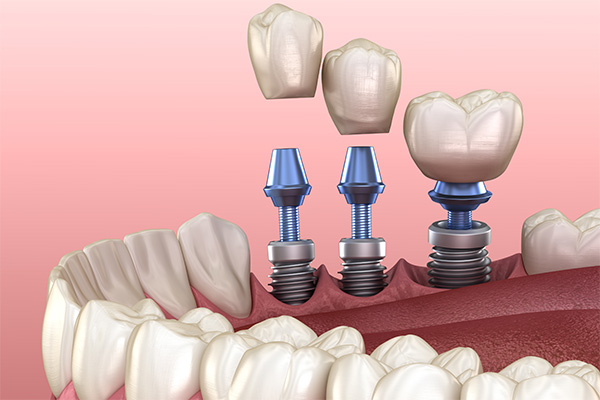
- As artificial teeth attached to dental implants
- To protect a tooth after a root canal
Smile makeover treatments aim to restore the appearance of the patient's teeth, but the use of crowns provides cosmetic and therapeutic benefits.
The different types of dental crowns
Dental crowns can be made from a variety of materials and each has its unique properties. This often dictates what type of crown the dentist decides to use during a smile makeover. The common types of crowns used in dentistry include:
- Stainless steel: These often come prefabricated and they are mostly used as temporary crowns. They are also used to protect the baby teeth of young patients when they are at risk of falling out prematurely
- Metal alloys: Crowns can be made from metal alloys that contain gold, silver, platinum or other metals. These are typically the least aesthetically-pleasing crowns, but they are also the most durable. They are more likely to be used for teeth in the back of the mouth during smile makeovers since they are not visible when a person smiles
- Porcelain fused to metal: These give patients a combination of the best of metal and porcelain crowns. They look just like real teeth, but they are more durable than all-porcelain crowns
- Porcelain: These types of crowns are most likely to be used during a smile makeover since they have the most natural-looking appearance
What to expect when getting a crown
The installation of a dental crown requires the removal of enamel so the crown fits snugly on the crown. This permanently changes the tooth and it will need to always be protected with a restoration moving forward. The dentist will inject the patient with a local anesthetic prior to removing enamel.
The patient's teeth are prepared and an impression is taken. The impression is sent to a lab that makes crowns. The finished product gets back to the dentist in about two weeks. The patient is fitted with temporary crowns that are removed once their customized crowns are ready.
Ready to fix your smile with crowns?
Call our Saratoga Springs clinic to learn more about how dental crowns can be used to improve the way your smile looks.
Request an appointment here: https://www.mysaratogadentist.com or call My Saratoga Dentist PLLC at (518) 675-3094 for an appointment in our Saratoga Springs office.
Check out what others are saying about our services on Yelp: Read our Yelp reviews.
Recent Posts
Full mouth reconstruction optimizes oral health, function, and the aesthetic quality of the entire smile when multiple dental issues occur simultaneously. This approach addresses extensive dental concerns all at once rather than treating teeth as separate problems with temporary solutions. Consulting a general dentist can help you create a clear roadmap to eliminate discomfort, correct…
Dental implants are a popular option for replacing missing teeth. While they offer the same aesthetic benefits as other replacement options, there are multiple other benefits provided by dental implants that alternatives fail to deliver.One crucial component of a dental implant is a titanium screw that is placed directly into the jawbone. The screw forms…
The options for replacing missing teeth have brought many people to choose between dentures and dental bridges. It is essential to replace missing teeth for several reasons. Your appearance is affected by missing teeth, and this alone is one of the main reasons people want to replace them. A missing tooth leaves behind a gap…
Dentures are a well-known option for replacing missing teeth that are often given a bad reputation in their reliability. We have all watched the childhood film, where the elderly character has their dentures fall out of their mouth at the dinner table. While this exaggerated age-old misconception is based on legitimate concerns of denture wearing,…